
The Finance Leader's Headcount Governance Playbook

Headcount is your largest expense line. At most companies, it represents 60-70% of total operating costs. And yet, for many finance leaders, it's also the expense line with the least real-time visibility and the weakest controls.
You wouldn't run your revenue forecast off a spreadsheet that gets updated once a month. You wouldn't let department heads approve six-figure purchases through Slack messages. But that's exactly how most organizations manage CFO headcount planning decisions today.
If you're a CFO or VP of Finance, you already know the symptoms: budget variance you can't explain until it's too late, headcount numbers that don't match between Finance and HR, and board meetings where you're defending workforce spend with data that's already stale. The fix isn't more planning rigor. It's governance, the enforcement layer that makes your headcount plan actually stick.
This playbook walks through the framework finance leaders need to take control of headcount governance, from budget enforcement to board reporting.

Why CFO Headcount Planning Is Broken at Most Companies
Let's start with the uncomfortable truth: finance leaders are responsible for headcount costs but often don't control the decisions that drive them.
Here's how it typically works. Finance builds a detailed headcount plan during the annual cycle. That plan gets approved by the executive team. And then execution happens in systems Finance doesn't own: the HRIS, the ATS, Slack conversations, email approvals. By the time the monthly close reveals a variance, the hiring already happened.
A 2025 Gartner survey found that only 29% of CFOs plan to increase HR spending in 2026, while average HR budget growth dropped from 2.4% to 0.7%. The message is clear: finance leaders are tightening headcount budgets. But tightening a budget only works if you can enforce it.
The core problem isn't the plan. It's the gap between the plan and what actually happens.
The Three Gaps That Kill Headcount Budgets
The approval gap. Headcount requests get approved without full cost context. A hiring manager asks for a backfill, a VP says yes in an email, and the req opens in the ATS. Nobody checked whether the role is funded at the requested compensation level. Nobody verified it was in the approved plan. The approval happened, but Finance wasn't in the loop.
The timing gap. Plans assume hiring happens on a timeline. Reality doesn't cooperate. Roles take longer to fill than expected, pushing costs into later quarters. Or they fill faster, pulling costs forward. Either way, your forecast is wrong, and you don't know it until close.
The data gap. Finance tracks headcount in the financial model. HR tracks it in the HRIS. Recruiting tracks it in the ATS. These systems don't talk to each other, and they use different definitions of what counts as "headcount." Reconciling them manually takes days and still produces numbers people argue about.
Building Budget Enforcement That Actually Works
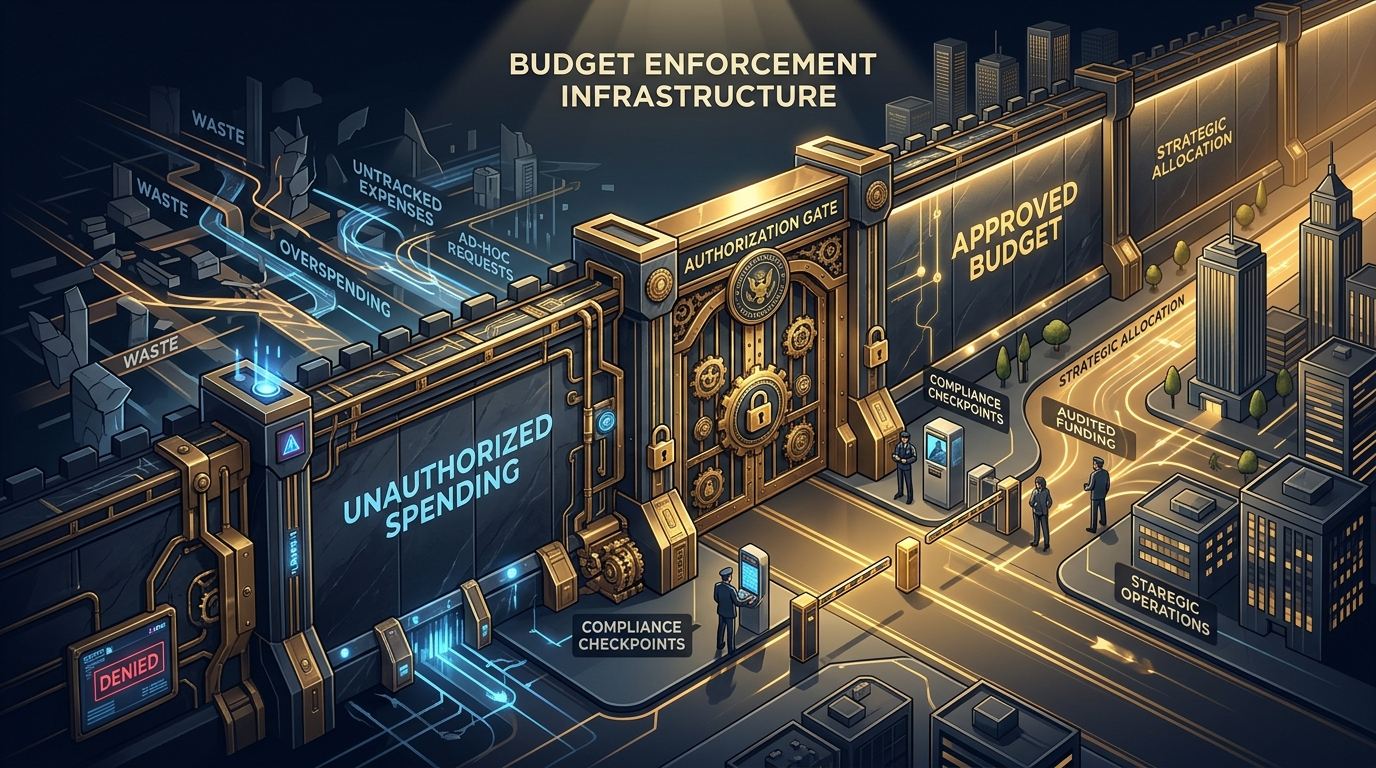
Budget enforcement is the first pillar of any headcount governance framework. Without it, your plan is a suggestion.
What Budget Enforcement Looks Like in Practice
Real budget enforcement means every headcount request is validated against the approved budget before it moves forward. Not after. Not at month-end. At the moment a manager submits the request.
This requires three things:
Cost context on every request. When a manager submits a headcount request, the approver needs to see the fully loaded cost: base salary, benefits, equity, bonus, equipment, and any other costs. They need to see where this role fits in the department's approved budget. Without this, approvals are guesswork.
Budget gates before the ATS. A requisition should not open in your ATS until it's been validated against the budget. This is the single most important control in headcount governance. It prevents ghost reqs, unfunded roles, and the expensive discovery three weeks later that a recruiter has been working a role that was never approved.
Exception tracking. Some roles will need to exceed the plan. That's normal. But every exception should be documented, approved at the right level, and visible to Finance in real time. No more discovering exceptions at month-end.
Organizations that implement this kind of enforcement through governance software report reducing headcount request volume by up to 40%. Not because they're blocking good hires, but because the friction of budget validation eliminates the speculative, "let's just open it and see" requests that waste everyone's time.

Forecast Accuracy: Moving From Monthly Variance to Continuous Tracking
If you're a CFO relying on monthly variance reports to track headcount, you're always looking backward. By the time you see the variance, the cost is already incurred.
The Continuous Forecast Model
The shift finance leaders need to make is from periodic reporting to continuous tracking. This means your headcount forecast updates automatically as changes happen: new hires, terminations, backfills, compensation changes, timeline shifts.
Here's what this looks like in practice:
Real-time plan vs. actual visibility. At any given moment, you should be able to see where you stand against the approved plan. How many roles are filled vs. planned? What's the cost variance? Which departments are over plan? This data should be live, not reconstructed monthly.
Rolling forecast integration. Your headcount data should feed directly into your financial forecast. When a role fills two months early, the cost impact should show up in your P&L forecast immediately, not in next month's variance report.
Scenario modeling on demand. When the CEO asks "what if we freeze hiring in engineering for a quarter?" you shouldn't need a week to model it. Scenario modeling should let you run that analysis in hours, using real data, and share the results with clear cost implications.
Gartner reports that 56% of CFOs rank cost management as their top priority, with 51% placing forecast accuracy in their top five. Continuous headcount tracking addresses both. You catch variances before they compound, and your forecasts stay accurate because they're built on real-time data, not month-old snapshots.

Board-Ready Reporting You Control
Every CFO knows the feeling: the board meeting is in three days, and you're scrambling to reconcile headcount numbers from four different systems so you can present a workforce slide you actually trust.
What Board-Ready Reporting Requires
Board reporting on headcount should answer three questions cleanly:
1. Where are we vs. plan? Total headcount, headcount by department, and variance from the approved plan. Not just numbers, but the story behind the variance.
2. What did it cost, and what will it cost? Fully loaded costs for current headcount, plus the projected cost of open and planned roles. The board wants to see run-rate impact, not just point-in-time snapshots.
3. What changed and why? A clear view of the decisions that drove variance. Were they strategic (we accelerated hiring in sales) or operational (we couldn't fill engineering roles on time)?
The only way to produce this reporting reliably is to have a single source of truth that connects your financial plan to your HRIS and ATS data. When those systems are connected through a unified platform, board prep stops being a fire drill and starts being a report you pull.
Companies that automate headcount reconciliation report eliminating 100% of manual data reconciliation between systems and reducing the time spent on admin tasks by 80%.
How Should Finance Leaders Think About the CFO's Expanding Role in Headcount?
The CFO's role in headcount decisions is growing. Deloitte found that 34% of finance leaders are taking a larger role in hiring decisions. And Gartner's 2026 CFO Agenda highlights that nearly 75% of CFOs are increasing technology spend while simultaneously trimming headcount budgets.
This isn't about Finance becoming the hiring police. It's about Finance having the infrastructure to be a strategic partner in workforce decisions.
From Gatekeeper to Strategic Partner
The old model: Finance approves a headcount plan once a year and then fights with HR about why the numbers don't match at quarter-end.
The new model: Finance has real-time visibility into headcount activity, automated budget enforcement that prevents off-plan hiring before it happens, and reporting that tells the workforce cost story clearly. Finance becomes the team that helps the business make better headcount decisions, not the team that says "no" after the fact.
This shift requires two things. First, a governance framework with clear rules about how headcount gets approved, at what cost thresholds, with what budget context. Second, technology that enforces those rules automatically and provides the data Finance needs to advise, not just audit.
When Seena Mojahedi built headcount processes at Google, Slack, and Coinbase, the consistent theme was that Finance needed infrastructure, not more meetings. The decisions weren't the problem. The lack of a system to enforce and track those decisions was the problem.
Conclusion
CFO headcount planning is evolving from an annual exercise to a continuous discipline. The finance leaders who get this right are the ones building governance infrastructure: budget enforcement that prevents off-plan hiring, continuous tracking that keeps forecasts accurate, and board reporting they control.
Your headcount plan is only as good as the system that enforces it. Without governance, you're managing your largest expense line on trust and monthly reconciliation.
Kinnect gives finance leaders the enforcement layer they've been missing: real-time budget gates, automated plan vs. actual tracking, and reporting built from a single source of truth. It's the infrastructure that turns your headcount plan from a document into a system of control.
Book a demo with Seena to see how finance leaders are taking control of headcount governance.