
The Real Cost of Ghost Reqs: Why Recruiters Work Roles That Don't Exist

A recruiter on your team has spent the last three weeks sourcing for a senior product manager role. They've screened 30 candidates, moved 8 to phone screens, and scheduled 3 onsite interviews. The hiring manager is engaged. The pipeline looks strong.
Then Finance flags the role. It was never in the approved headcount plan. The budget doesn't exist. The req gets killed, the candidates get a rejection email, and the recruiter just lost three weeks of capacity on a role that was never real.
This is a ghost requisition. And if you think it's rare, you're wrong.
Ghost requisitions in recruiting are one of the most expensive and least discussed problems in workforce management. They happen when there's no enforcement layer between headcount approval and the ATS. A manager opens a req, recruiting goes to work, and nobody checks whether the role is actually funded until it's too late. The result: wasted recruiter time, damaged candidate experience, and headcount budgets that bleed in ways nobody can track.

What Exactly Is a Ghost Requisition?
A ghost requisition is any open role in your ATS that isn't backed by an approved, funded position in your headcount plan. Ghost reqs take several forms:
The never-approved req. A hiring manager submits a req directly in the ATS, bypassing the headcount approval process entirely. It was never in the plan, never reviewed by Finance, and never validated against the budget. But it's open, and a recruiter is working it.
The zombie backfill. Someone leaves the company, and a manager immediately opens a backfill req. But the backfill wasn't budgeted at the departing employee's level, or the position was slated for elimination, or the budget was already reallocated. The req is open, but the funding isn't there.
The frozen-but-still-open req. A hiring freeze hits, but nobody closes the affected reqs in the ATS. Recruiters keep working them because the system says they're active. Candidates keep applying because the job is still posted. Weeks pass before anyone cleans up the mess.
The over-budget req. The role was approved, but at a lower compensation band. The hiring manager updated the req with a higher salary range to attract better candidates. The req is technically funded, but not at the level it's being recruited for. The offer will either get rejected by Finance or blow the budget.
Research shows that roughly 30-40% of job postings at any given time can be considered ghost jobs, roles that are posted with no real intent to hire, no approved budget, or no clear path to an offer. That's not a rounding error. That's a structural problem.

The Real Cost of Ghost Requisitions Recruiting Teams Bear
Ghost reqs don't show up on a balance sheet. Their cost is hidden in wasted capacity, damaged relationships, and eroded trust between departments.
Recruiter Capacity Wasted
The average recruiter works 10 or more requisitions at any given time. Internal data from major ATS platforms shows recruiter workload increased by 26% in recent quarters. Every ghost req on a recruiter's plate displaces a real, funded, approved role that could be filled.
If a recruiter spends three weeks on a ghost req before it's killed, that's three weeks of sourcing, screening, and coordinating interviews that produced zero hires. Multiply that across a recruiting team, and the capacity loss is staggering.
Organizations that implement headcount governance report a 30% improvement in hiring efficiency and a 50% reduction in requisition management time. The gains don't come from making recruiters work harder. They come from ensuring recruiters only work roles that are real.
Candidate Experience Destroyed
Every ghost req that gets killed leaves a trail of candidates who were engaged, interviewed, and then rejected for reasons that have nothing to do with their qualifications. They didn't lose the role. The role never existed.
In a competitive talent market, this matters. Those candidates talk. They leave Glassdoor reviews. They tell their networks. They remember your company as the one that wasted their time. And when you have a real role to fill six months later, they're not coming back.
Finance-Recruiting Trust Eroded
Ghost reqs create a toxic cycle between Finance and Recruiting. Finance sees reqs opening for roles that aren't in the plan and starts questioning every hiring request. Recruiting sees Finance killing reqs mid-process and starts viewing Finance as an obstacle. Both sides lose trust, and the resulting friction slows down legitimate hiring.
The fix isn't better communication. It's better infrastructure. When every req is validated against the budget before it reaches a recruiter, Finance doesn't need to play catch-up, and Recruiting doesn't get burned.
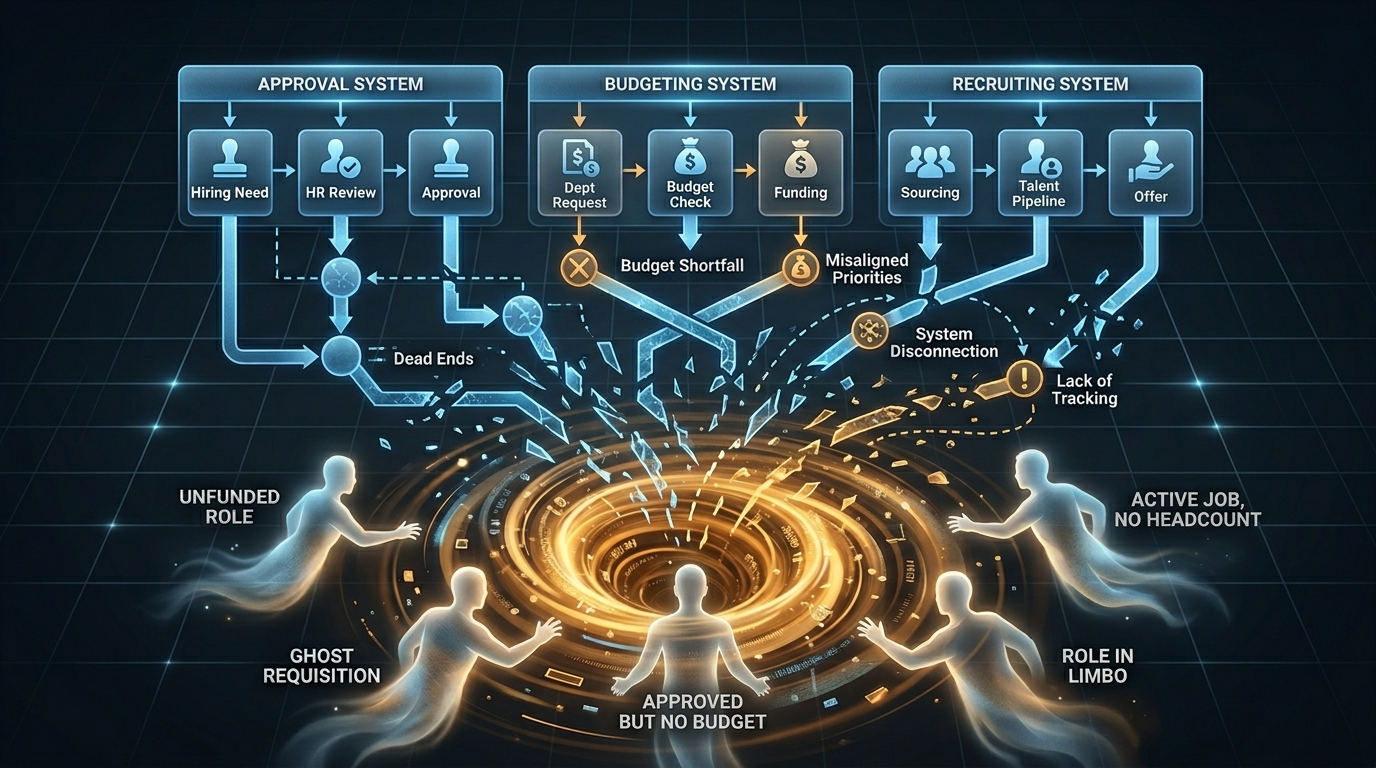
Where Do Ghost Requisitions Come From?
Ghost reqs aren't malicious. Hiring managers don't wake up thinking "I'll submit an unfunded req today." They happen because of systemic gaps in how headcount gets approved and operationalized.
The Approval-to-ATS Gap
At most companies, headcount approval and ATS req creation are disconnected processes. Approval might happen in email, Slack, or a planning meeting. Req creation happens in Greenhouse, Lever, or another ATS. There's no automated connection between the two.
This means a manager can open a req in the ATS without any system checking whether the role was approved, funded, or in the plan. The ATS doesn't know about the budget. The budget system doesn't know about the ATS. The gap between them is where ghost reqs are born.
No Budget Validation at Point of Req Creation
Even when there's a formal approval process, it rarely includes real-time budget validation. A VP approves a headcount request, but nobody checks whether the department's budget can actually absorb the cost at the requested compensation level. The approval is about intent, not financial reality.
By the time Finance reviews the numbers, the req has been open for weeks and a recruiter is deep into sourcing. Killing it now is expensive. Letting it proceed is off-plan. There's no good answer, and the root cause was skipping budget validation at the start.
Backfill Assumptions
Many organizations treat backfills as automatically approved. Someone leaves, the backfill opens. But not every departure should trigger a backfill. Maybe the role was over-leveled. Maybe the team is being restructured. Maybe the budget was already tight before the departure.
Without a governance check on backfills, they flow straight into the ATS and onto a recruiter's plate. The manager assumes it's approved because "it's just a backfill." Finance assumes someone validated it. Nobody did.

How to Eliminate Ghost Requisitions
The fix is straightforward in concept and requires infrastructure in practice. You need to close the gap between headcount approval and ATS req creation.
Budget Gates Before the ATS
Every requisition should be validated against the approved headcount plan before it enters the ATS. This means:
The role exists in the approved plan (or has been explicitly approved as an exception)
The compensation level matches what was budgeted
The cost has been validated against the department's remaining budget
The required approvals are documented with an audit trail
When these checks happen automatically, ghost reqs become structurally impossible. A req can't open in the ATS unless it's funded. Headcount governance software makes this automatic rather than manual.
ATS Integration That Enforces Governance
Your governance system needs to connect directly to your ATS. When a role is approved and funded, it flows into the ATS automatically. When it's not approved, it doesn't. The recruiter never sees unfunded roles because unfunded roles never make it into the system they work from.
This is why ATS integration matters. It's not about syncing data after the fact. It's about creating a governed pipeline from approval to req creation that eliminates the gap where ghost reqs live.
Backfill Governance
Backfills need the same governance as new roles. When a termination triggers a potential backfill, the system should:
Check whether the position is still funded in the current plan
Validate the compensation level against the budget (not just the departing employee's salary)
Route the backfill through the appropriate approval workflow
Only create the req in the ATS after all checks pass
Organizations using automated headcount workflows report a 70% reduction in time spent on termination-related position management. That's because the system handles the governance check instead of requiring manual intervention from Finance, HR, and the hiring manager.
Conclusion
Ghost requisitions in recruiting are a symptom of a governance gap. When there's no enforcement between headcount approval and the ATS, unfunded roles slip through, and recruiters waste weeks on positions that were never real. The cost shows up in lost capacity, damaged candidate relationships, and headcount budgets nobody trusts.
The fix is governance infrastructure that validates every req against the budget before it reaches a recruiter. Budget gates, ATS integration, and backfill governance close the gap where ghost reqs are born.
Kinnect connects your approved headcount plan directly to your ATS through the hiring tracker, ensuring every requisition is funded and approved before a recruiter touches it. No more ghost reqs. No more wasted capacity. No more explaining to the board why you're 15 roles over plan.
Book a demo with Seena to see how governance eliminates ghost reqs and gives your recruiting team back the capacity they're losing today.