Streamline Job Requisition Management: Automate Your Workday-Greenhouse Integration

Here's the challenge every HR and Recruiting Operations leader faces with Workday-Greenhouse integration: You need complete governance over job requisition creation, but traditional integration approaches require months of expensive Workday Studio development, complex data mapping, and ongoing technical maintenance that drains your resources.
The real issue isn't speed—it's control. You need to establish Workday as the authoritative system of record for job requisitions while ensuring seamless data flow to Greenhouse. But most integration approaches force you to choose between governance and simplicity, leaving you with either inadequate oversight or technical complexity that requires specialized expertise to maintain.
When you get Greenhouse-Workday integration right, you establish true governance over your hiring process: controlled job requisition creation, consistent data accuracy, and streamlined workflows that support your headcount management software strategy rather than undermining it.
Why Manual Job Posting Creation Can Be a Nightmare
Without proper Workday-Greenhouse integration, organizations lose fundamental control over their job requisition governance. This creates operational inefficiencies that compound over time:
Fragmented job creation processes: Multiple stakeholders create job requisitions in different systems without centralized oversight or approval workflows. This eliminates your ability to govern who creates requisitions, when they're created, and whether they align with approved headcount budgets.
Data consistency breakdown: Job requisitions created directly in Greenhouse bypass Workday's foundational data structures, leading to mismatched job profiles and organizational assignments. When these roles get filled, the resulting employee data doesn't align with your HRIS structure. Further, it takes longer to create a job requisition manually, and there is a greater risk of human error.
Governance and compliance gaps: Manual processes make it impossible to establish proper oversight of job requisition creation and editing. Organizations lose visibility into whether job postings match actual hiring authority, approved budgets, or organizational requirements.
Integration troubleshooting overhead: When job requisition data doesn't flow properly between systems, someone needs to manually identify and resolve data mismatches. This operational burden typically falls on HR Operations teams that may not fully understand Workday integration maintenance, as well as a Workday integration expert.
Here is an example of the manual job requisition creation process in Workday and the number of steps involved.

Workday Studio: 7 Steps to Building the Workday-Greenhouse Integration

Building effective Workday-Greenhouse integration requires a systematic approach that starts with data architecture and ends with bulletproof validation. The process typically costs $12,000-$15,000 for outbound integration alone and takes 6-12 weeks to implement properly, including testing and deploying the Workday Studio integration and corresponding functional processes into production.
Here’s how to do it.
1. Create RaaS Report for Position and Job Requisition Data
Create a comprehensive RaaS (Report-as-a-Service) report containing all position and job requisition data that needs to flow to Greenhouse. This includes ~10-20 fields covering:
Job profiles
Organizational assignments
Compensation data (including grade profiles and pay ranges)
Any custom metadata your recruiting process requires
This report is the foundation for maintaining data consistency between systems.
2. Build Calculated Fields for Data Transformation
Create calculated fields needed for the RaaS report to transform Workday's foundation and organizational structures into formats that Greenhouse can process. These fields bridge the gap between Workday's complex hierarchical data and Greenhouse's flatter organizational model so you have consistent data interpretation across systems.
3. Develop a Custom Workday Studio Integration
Build a custom Workday Studio integration using Workday's Eclipse-based IDE to handle both job creation and job update calls to Greenhouse. Workday Studio provides the flexibility needed for complex data mapping and seamless Workday-Greenhouse integration, but requires specialized technical expertise that most organizations don't have in-house.
4. Implement Data Mapping and Validation
Create additional calculated fields within the Workday Studio integration for data mapping to Greenhouse custom fields. Set up validation rules that catch data mismatches before they cause integration failures, such as ensuring all organizational values in Workday have corresponding entries in Greenhouse.
Here’s an additional setup on Greenhouse’s side:

5. Test Integration Scenarios Thoroughly
We can’t stress this enough: Test, test, and test again. Test all integration scenarios extensively to identify potential failure points and data mapping issues. This testing phase is critical because Workday Studio integrations can fail when encountering unexpected data combinations, custom field modifications, or organizational changes.
6. Update Workday Business Processes
Update the business processes in Workday for both Create and Edit Job Requisition to trigger the integration automatically. Configure these workflows to automatically initiate data transfer when job requisitions are created or modified. These workflow updates ensure that job requisition governance flows through Workday while maintaining real-time synchronization with Greenhouse.
Pro Tip: Set up alerting for when the Workday-Greenhouse integration fails so you can be informed of errors in real time.
7. Ensure Edit Flow Updates Existing Greenhouse Jobs
Configure the integration to automatically update corresponding Greenhouse job postings when someone edits a job requisition in Workday. This requires separate API calls and careful data synchronization to maintain consistency across both systems.
The complexity of Workday Studio integrations means they require ongoing maintenance whenever business processes or data structures change. That makes this approach expensive and technically demanding to maintain long-term.
Automate Outbound Workday-Greenhouse Integration with Intuitive Workday Headcount Management Software
Our intuitive headcount management software Kinnect eliminates the manual job posting nightmare by providing plug-and-play Workday-Greenhouse integration that works immediately without expensive Workday Studio development or months of implementation time. This establishes the governance controls that HR and Recruiting Operations leaders need to maintain oversight of their job requisition process. Here’s how.
No-Code Integration Setup
Our headcount management software connects to both Workday and Greenhouse through a simple drag-and-drop configuration that takes less than an hour to complete.

Kinnect's drag-and-drop integration interface makes Workday integrations effortless.
Instead of requiring specialized Workday Studio expertise and months of development time, administrators use our intuitive interface to map Workday fields to Greenhouse requirements and have the integration fully functional in minutes! The system automatically pulls available custom field options from the Greenhouse Harvest API so you get perfect data alignment without manual configuration.
Real-Time Position to Requisition Synchronization
When you start recruiting for an approved position in Kinnect, our Workday-Greenhouse integration automatically creates the job posting in Greenhouse with complete data accuracy.
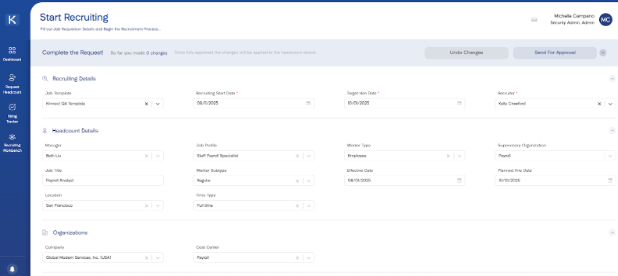
All position data flows to Greenhouse without any manual data entry, including:
Job title
Organizational assignments
Compensation ranges
Requirements
Because we’re constantly ingesting Workday data and keeping it synchronous and reconciled with Workday, the integrity of the Workday foundation data as the source of truth is retained while ensuring recruiting teams work with current, approved, up-to-date, accurate, and complete position information.
Automated Job Posting Management
Our headcount management software handles both Workday-Greenhouse job requisition creation and job requisition updates automatically through intelligent workflow management. When someone edits job requisition details in Kinnect, those changes instantly update the corresponding Greenhouse job. This synchronization ensures recruiting teams never work with outdated information while maintaining complete governance over job requisition changes.

For example, when a department head approves a new Payroll Analyst position, the requisition flows through Kinnect's headcount management workflows before automatically creating the Greenhouse job requisition. If they need to adjust requirements or compensation later, those changes flow to Greenhouse immediately while maintaining complete audit trails and the integrity of the Workday foundation data.

Seamless Data Validation and Error Prevention
Traditional Workday Studio integrations can fail when data doesn't match perfectly. To combat this, Kinnect proactively validates all information before sending it to Greenhouse. Our Workday-Greenhouse integration prevents the integration failures that typically block recruiting starts so your headcount management workflows never break down due to technical issues.
The result is Greenhouse-Workday integration that establishes true governance over job requisition management while eliminating the technical complexity and ongoing maintenance overhead of custom Workday Studio development. You save $15,000-$20,000 in initial implementation costs while eliminating the ongoing technical expertise requirements that make traditional integrations expensive to maintain.
You Can End the Duplicate Requisition Nightmare
Manual job requisition creation doesn't have to drain your recruiting team's productivity or create data integrity chaos across your systems. When you automate Workday-Greenhouse integration with the right approach, job requisition management becomes a strategic advantage that supports your governance objectives for headcount management and strategic workforce planning rather than undermining them.
Kinnect's headcount management software eliminates these challenges by providing instant, no-code Workday-Greenhouse integration that works seamlessly without expensive Workday Studio development. Our platform establishes Workday as your authoritative system of record while ensuring seamless, automated data flow to Greenhouse.
The result? Organizations using Kinnect save $15,000-$20,000 in initial implementation costs while freeing up 10-15 hours per week of recruiting team time previously spent on manual job posting creation and data reconciliation. Plus, teams typically see recruiting efficiency improvements of 40% within their first month and achieve complete job requisition governance without the operational overhead of managing complex integrations.
Stop letting technical complexity prevent you from establishing proper governance over your job requisition process. Book your free personalized demo today and discover how Kinnect transforms Workday-Greenhouse integration from a technical challenge into a streamlined governance solution.